

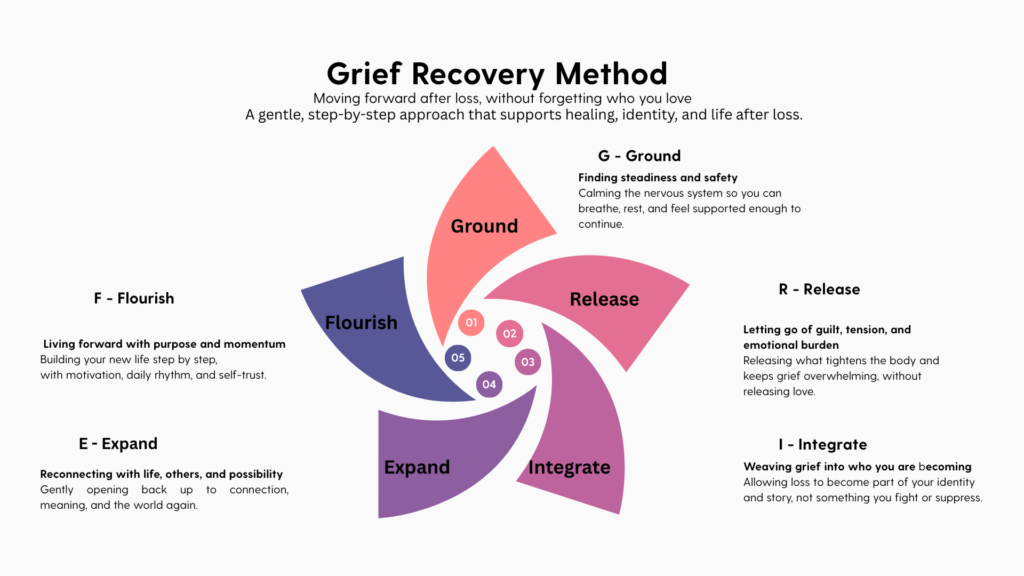
A Permission‑Based Way to Be With Grief
Grief is often spoken about as something to work through, move past, or heal from.
Many women I meet arrive carrying not only their loss, but also the quiet weight of expectations — expectations about how they should feel, how long it should last, and who they should be by now.
The GRIEF Method was created as a gentle alternative to that pressure.
It is not a programme to complete, a set of stages to master, or a path toward an outcome you must reach. It is a permission‑based way of being with grief — one that honours feelings, respects the body, and moves at a human pace.
Why I Created the GRIEF Method
After loss, many women are met with advice, timelines, and encouragement to cope better or move forward.
What is often missing is permission:
Permission to feel what is actually here.
Permission to go slowly.
Permission to grieve without explaining or fixing.
The GRIEF Method exists to offer that permission — alongside a steady, compassionate guide.
GRIEF Is Not a Process
GRIEF is not a checklist, and it is not something you move through in order.
You may return to one part again and again, or find that one letter matters more than the others right now. You may skip parts entirely.
The method is simply a quiet map I hold, so you do not have to hold everything alone.
The GRIEF Method
G — Give Permission
Grief begins with permission.
Permission to feel what is here without judging it, managing it, or rushing it away.
You do not need to be strong.
You do not need to be positive.
You do not need to make sense of your feelings.
Giving permission allows grief to soften its grip, because it no longer has to fight to be acknowledged.
R — Recognise the Feeling
Rather than analysing emotions, the GRIEF Method invites gentle recognition.
This might sound like:
- “This feels heavy.”
- “There is anger here.”
- “I don’t know what I’m feeling today.”
All of these are complete and valid.
Feelings do not need fixing to be felt.
I — Include the Body
Grief lives in the body as much as it lives in the heart.
Fatigue, tension, numbness, tightness, or restlessness are not signs that something is wrong — they are often the body’s way of carrying loss.
Including the body means listening gently, without forcing release or understanding.
Rest is not avoidance.
Numbness is not failure.
E — Ease the Pressure
Much of the suffering around grief comes not from the loss itself, but from pressure:
Pressure to heal.
Pressure to move on.
Pressure to be different by now.
The GRIEF Method invites you to set those expectations down.
There is no timeline.
There is no correct pace.
Easing pressure creates room for breath.
F — Follow What Softens
Rather than searching for meaning or growth, the GRIEF Method notices something gentler: softening.
Softening might be:
- A deeper breath
- A moment of calm
- Less resistance
- A quiet sense of okay
Nothing has to disappear for something to soften.
Who the GRIEF Method Is For
This approach is for women who have lost a partner, parent, or child and are tired of being told how they should be grieving.
It is for those who want:
- Emotional permission rather than advice
- Steady presence rather than fixing
- Support that respects their pace
You do not need to be ready.
You do not need clarity.
How I Work With the GRIEF Method
I use the GRIEF Method across my work — in audio reflections, companion books, content, and private 1:1 support.
It quietly shapes the space so that:
- You are not rushed
- Your feelings are not pathologised
- You are met with steadiness and care
This is not about moving on.
It is about being met.
A Gentle Invitation
If reading this feels like a quiet exhale, you may wish to explore my permission‑based support further.
I invite you to take advantage of this 30-minute free Initial Consultation.
https://tidycal.com/gwendilinegould/30-minute-meeting
You are welcome to take your time. You are welcome to begin slowly.
Grief does not ask to be solved. It asks to be met — gently, and at your own pace.